Attracting 500+ professional buyers and procurement delegations from over 60 countries, the Expo acts as a vital platform for green-low-carbon tech display, international trade and project cooperation.
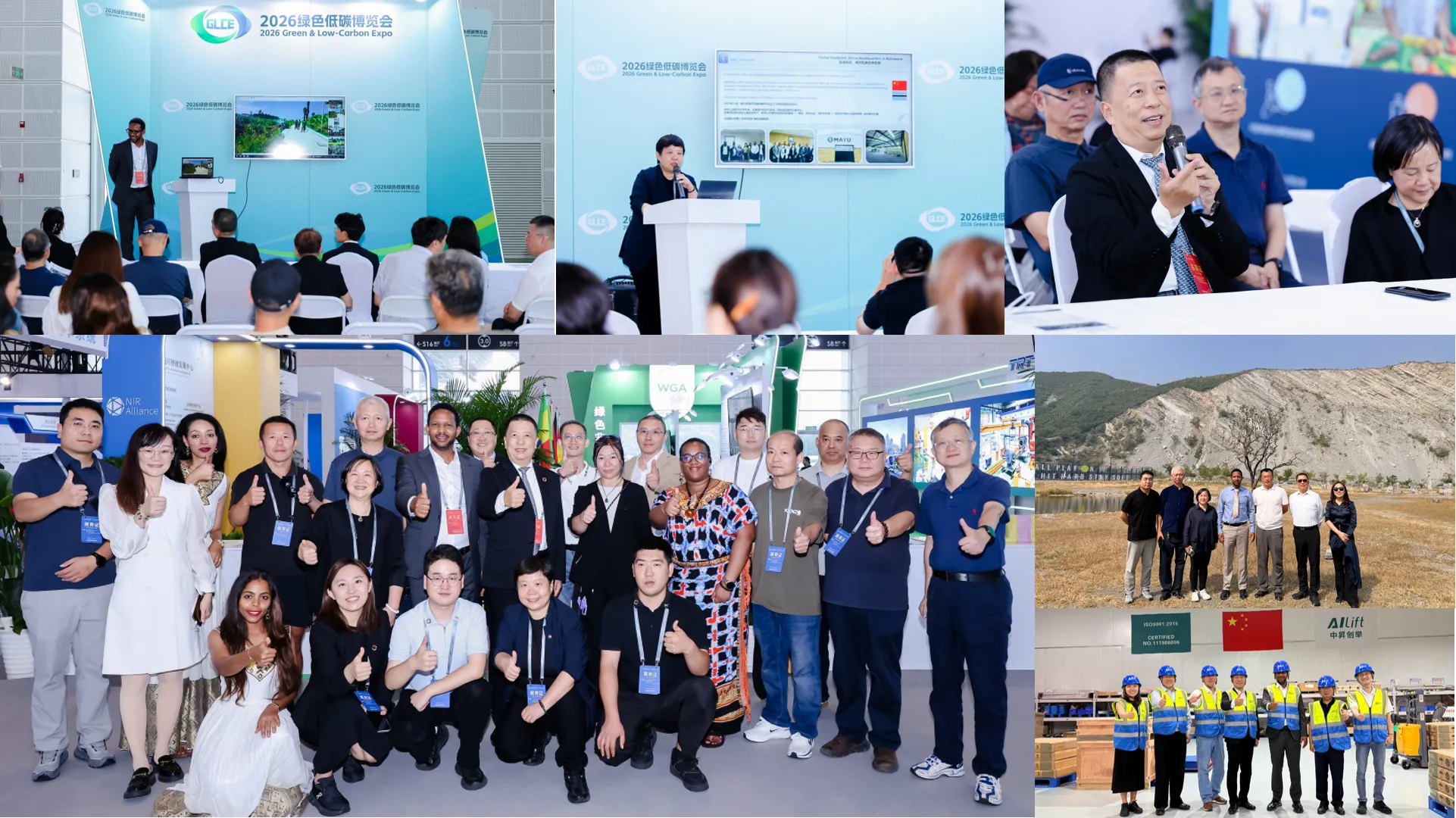
From 16 to 18 September 2026, the Global New Industrial Revolution Alliance (NIRA), together with the World Economic Council (WEC), Window of Green Africa (WGA), and a group of green and low-carbon enterprises, participated in the 2026 Green and Low-Carbon Expo and International Engineering and Construction Expo in Tianjin. The Expo attracted more than 500 professional buyers and procurement delegations from over 60 countries, providing an important platform for showcasing green and low-carbon technologies, facilitating international trade and economic exchanges, and advancing project cooperation.
The joint NIRA–WEC–WGA pavilion presented innovative solutions in green infrastructure, smart agriculture, and sustainable construction. Together, these solutions offered a systematic, value-chain-wide approach to supporting countries in the Global South, particularly in Africa—from “Zero Hunger” to “A Nourished World,” from clean water and sanitation under SDG 6 to soil restoration, and from modular construction to “Housing for All.” The pavilion demonstrated how Chinese expertise, technologies, and integrated solutions can contribute to global sustainable development.
While touring the joint pavilion, Ms. Zhu Yong, Director of the China Foreign Trade Centre; Mr. Zhang Yi, Executive Vice President of the National Convention and Exhibition Centre (Tianjin) Co., Ltd.; Mr. James George, Deputy Resident Representative of the United Nations Development Programme in China; and relevant Tianjin municipal officials visited the booth, where participating delegates held exchanges with them.
Professor Yabin Wu, Secretary-General of NIRA and WEC Ambassador and China Country Representative, attended the Expo alongside Mr. Kaleb Menwyelet Munacha, WEC Ambassador for Africa & Africa Chapter Leader, Founder of WGA. They engaged in in-depth discussions with representatives of government agencies, international organizations, industry bodies, and enterprises, and shared their perspectives in media interviews.
Headquartered in Vienna, Austria, the World Economic Council (WEC) serves as the umbrella organization of the Berlin-based International Economic Senate (IWS). It brings together business leaders, scientists, and policymakers to connect business, policy, and technology and advance responsible global cooperation.

Window of Green Africa (WGA) highlighted its integrated green infrastructure solutions centred on ecological restoration and water environment management. Through its affiliated companies, Etoile General Contractor PLC and View Unlimited Green Development Consultant, WGA has delivered a number of landmark national projects. These include Sheger Park along the riverfront in Addis Ababa; the planning, design, and construction of Ethiopia’s New National Palace at Chaka House; and the overall environmental design of the Administrative Office Area in Beijing’s Municipal Administrative Center.

With water environments serving as a unifying element, these projects combine river restoration, drainage system reconstruction, wetland rehabilitation, and the creation of public spaces, achieving an integrated balance between ecological stewardship, urban functionality, and public life. WGA is actively working to bring this expertise to Tanzania and the wider East African market.
The atmospheric water generation solution harnesses air and solar energy to create a viable “third source of water.” With a focus on both technological development and practical deployment, it offers a sustainable response to global water scarcity and water pollution.
Built on independently developed core technologies, this pioneering solution overcomes many of the climatic limitations faced by conventional systems. It can produce water continuously and reliably even under extreme conditions, including plateaus, deserts, and cold, high-altitude environments. The quality of the water produced meets or exceeds China’s national standards for direct drinking water. The technology is designed to support ecological restoration in arid and semi-arid regions, combat global desertification, and improve the efficiency of water-resource utilization.
The smart agriculture exhibit featured an intelligent, full-value-chain solution for edible mushroom cultivation. By integrating artificial intelligence algorithms, Internet of Things sensors, and clean-production management, the system creates a mobile and fully traceable “plant factory.”
Its core technologies include intelligent cultivation, cloud-based control, remote monitoring, smart heat pumps, high-efficiency humidification, ultraviolet disinfection, and LED supplementary lighting. These technologies enable precise control of temperature, humidity, lighting, and carbon dioxide levels, supporting stable year-round production while reducing water and energy consumption.
The company also provides one-stop services covering site selection and planning, equipment installation, technical training, mushroom spawn supply, and product sales, supporting the scalable, standardized, and low-carbon development of modern agriculture.
The modular construction exhibit presented an integrated steel-structure building system based on the model of “factory manufacturing and on-site assembly.” It brings planning and design, manufacturing, transportation, installation, and after-sales services into a complete industrial value chain.
The system can significantly shorten construction timelines, improve project quality and resource efficiency, and reduce construction waste and environmental impacts at the project site. Applicable to commercial, residential, and public facilities, it offers a practical pathway towards greener, lower-carbon, energy-efficient, and more sustainable construction.
.webp)
During the Expo, WGA held a special roadshow on international cooperation, featuring live video discussions with representatives of overseas governments, businesses, universities, and the Tanzania Green Summit, which was taking place concurrently.
Participants exchanged views on green infrastructure development in Africa, water security, ecological restoration, the localization of technologies, and mechanisms for project cooperation. The combination of on-site and virtual participation broadened the event’s international reach and established direct channels for subsequent technology introduction, joint implementation, and project delivery.
AtmosQua® also held a dedicated roadshow to present its atmospheric water generation technology, attracting considerable attention from professional visitors and international buyers.
The joint NIRA–WEC–WGA pavilion welcomed government officials, industry organizations, buyers, and business representatives from a wide range of countries and regions. Discussions focused on the application of green technologies, international market expansion, project cooperation, and resource matching. Participants also explored the potential deployment of the featured solutions in Africa and other markets across the Global South.
Participation in the Expo marked an important step in NIRA’s efforts to foster collaboration among international partners and accelerate the cross-border application of green technologies. By connecting WEC’s international network, WGA’s market resources in Africa, and the technological and industrial capabilities of Chinese enterprises, NIRA further strengthened its role as a platform for cross-regional resource integration and project cooperation.
During their visit to Tianjin, the delegation also conducted field visits to the Eden (Chunshanli) in Jizhou and AILift (Tianjin) Science Co., Ltd.
Looking ahead, NIRA will continue to advance cooperation in key areas including the New Industrial Revolution, artificial intelligence, and sustainable development. It will work to connect technology, capital, industry, and international markets more effectively; support the deployment of green and low-carbon solutions in Africa and other countries of the Global South; and help transform international cooperation from dialogue and demonstration into tangible project implementation.